KinderGals

Search This Blog

Tuesday, July 7, 2015

Reading, Writing, Math & Science Oh MY! AND a FREE Music Book

 Can't get to a conference but want PD? This blog post shares some snippets from some of the workshops that I can do.  BUT, you can always bring me to your school, too! Be sure and read all the way to the bottom of this blog post to snag up a FREE File!
Small Group Math
Slide7
Let's talk about planning small group number activities that are differentiated. A few weeks ago I went on a family beach trip. Ginny, my daughter in law who teaches first grade, was reading this book.
When she put it down….I picked it up! It tells us, “The development of number concepts is the foundation and heart for the mathematics program for young children.” It also said, “Children develop a real sense of number by working with real things rather than with symbols.”
Here is some important information that I share about how children best learn number. It is important to know that children can often answer the questions even when you are working at the symbolic level and still lack understanding. This is because they lack the logic of mathematics.
  • Start ALL learning at the conceptual level.
    1. First, use the real objects. (real apples)
    2. Then, move to a 3D model of the object. (apple erasers)
    3. Then, move to a 2D model of the object. (paper apples)
    4. Last, move to an object representing the object. (red unifix cubes to represent apples)
  • Next move to the pictorial level.
    1. Invite the children to draw a picture to show a number of apples.
    2. Look at a picture of apples and count how many.
  • Last, move to the abstract level.
    1. Use numerals to represent how many apples.
    2. Use symbols such as =, +, –.
Want to see more ideas on how to organize and manage differentiated centers? Here is a blog post with some great organization ideas.
http://kindergals.blogspot.com/2015/07/throwback-thursdaysetting-up-your-math.html
Writer's Workshop
Slide8
I love, love, love to teach writing to both kids and to teachers! So needless to say, I am always thrilled when I get to present one of my writing sessions.  Anchor Charts are an important part of the workshop model. So, just what is an anchor chart? Anchor charts must meet three criteria:
  1. An anchor chart is constructed with the kids.
  2. An anchor chart is actively being used as a reference.
  3. An anchor chart is a bulleted list of the big ideas from your mini lessons.
Number 2 and 3 might be clear, but you might wonder about number 1. How can they be actively engaged in making a chart when it looks like a poster? Well, I am left handed and a little OCD, so hanging up a chart that I have written with the kids kinda sent me over the edge. So…I would rewrite them. Have you ever done that? Be honest, because most of us probably have. The problem with that….the new chart WASN’T made with the children. They probably have no clue what is on it.
Here is how I do the charts:
  1. I make the charts ahead of time to match the big ideas from my mini lessons.
  2. I laminate the chart.
  3. I use white bulletin board paper, or another sheet of poster board, to cover the words.
  4. Each day, I “lower” the paper to “reveal” the new idea!
ABC's and 123's
Slide9

 Have you ever seen these little music books by CTP? Jean Feldman and Greg and Steve both have them. Here’s what I did:
  1. I bought the CD.
  2. I bought some sticky CD pockets from an office supply store.
  3. I took a blank CD and burned just the song to match the book.
  4. I put the CD inside of the sticky pocket.
  5. Now it makes a great listening center.
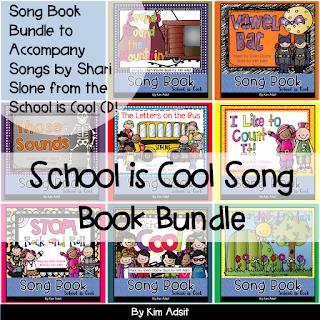
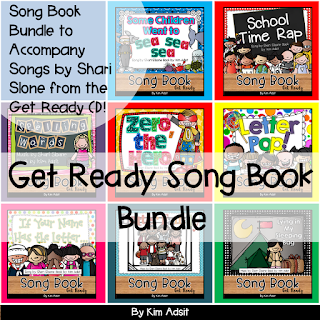
It then came to me, YOU CAN MAKE your own music books. So, I asked Shari and Jack if I could make some music books to go with their songs. My kids love them!
You can find Shari's music books here.
https://www.teacherspayteachers.com/Product/Shari-Sloane-School-is-Cool-Music-Books-Bundle-by-Kim-Adsit-1741500
And here.
https://www.teacherspayteachers.com/Product/Shari-Sloane-Get-Ready-Music-Books-Bundle-by-Kim-Adsit-1741496
And Jack's here.
https://www.teacherspayteachers.com/Product/Jack-Hartmann-Fun-Music-Book-Mega-Bundle-2437898
Mixing Up Some Math and Science Fun
Slide10
This session is a little science and a little math and some activities that are science AND math! My kids loved this idea…
  1. First, find non-fiction text about wheels and how they are helpful.
  2. Then, collect  some matchbox cars.
  3. Pour some tempera paint onto a sponge that I put into a bowl. Not a lot, just enough to make the sponge wet.  I made several different colors in several different bowls.
  4. Cut out a car shape from paper (finger painting paper works best).
  5. Invite the children to roll the cars around on the paper.
  6. On another day, have children write a non-fiction piece about wheels.
  7. Publish the piece by attaching it to the painted car.
Remember what Marcia Tate tells us….art is a way to grow dendrites!  Do you think they will remember what they learned about wheels after this activity? Yep, I think so, too!
Free File Music Book
And now for the freebee….Here is a little music book that you can use for singing Wheels on the Bus. I am sure that you will have no problem finding this song on one of your CDs. If you do, go to itunes and I bet you can pick it up for less than a buck!


Pin It!

Monday, July 6, 2015

Games, Science and Organization! And A FREE File to Get You Organized

Ever wonder what kinds of topics I present?  Here are a few snippets from some of the sessions during a recent conference. Be sure and read all the way to the bottom! I have a FREE File for you!
Slide1
Phonemic Fun for Everyone
Want  to work smarter, not harder? One way--“recycle” game ideas. This means taking an older game idea and adding a little bit of a different twist to make the kids think they are playing a whole new game! Here is an example for Penguin Bingo!
  • Take ANY abc bingo game and put it with a deck of beginning sound cards.
  • Say the name of the item on the card and the kids have to cover the letter the picture begins with.
  • Now the game has moved from an ABC recognition game to a beginning sound game! No need to make a new game!
Literacy Games and More
Slide2

Here is another way to “recycle” game ideas. This time we are going to play the same exact game, just change the clip art.  The kids think they are playing different games. But, we aren't wasting any time teaching more rules and procedures.  Here's how we play:
  • Hangman is a great game! You can play it using almost any theme….build Santa, add flowers to a pot, build a house, etc.
  • Another easy way to play is just to use a wooden puzzle. As they guess a letter that isn’t in the word, put a piece of the puzzle in the tray. Can they guess the word before you build the puzzle?
  • REMEMBER….we are using hangman as a game to teach! It’s easy to get caught up in winning and losing when you are as competitive as me!
  • Here are a few ways to get more out of the game:
    • Give the children a list of the words you are choosing from.
    • Tell the children how many letters are in the word, and invite them to draw that many lines on their boards.
    • Proceed to read the words down the list, deciding which ones it could be.
    • Have the children write their guess on their lines.
    • Now, invite a child to guess a letter.
    • If the letter is in your word, write it in the correct spot.
    • Now, invite the children to look at their word and see if they have that same letter in that same spot.
    • If not, they erase their word. Read through the list again deciding which word it could be and write another guess down.
    • Continue until the word is figured out!
    • This calls more attention to actually READING the words! 
Science Blasters 
I love, love, love  science. The main goal in kindergarten is to teach a love for science and the scientific process. Each experiment will take them through the process:
  • Ask a question
  • Do research or ask yourself, “What do you already know?”
  • Construct a hypothesis, “What do you think will happen?”
  • Test hypothesis through an experiment.
  • Analyze your data and draw a conclusion.
  • Communicate your results.
Slide3
So here’s how this lesson would go:
  • First, read a non-fiction book about ducks and their feathers. You may only need to read a small section from a non-fiction book.
  • Next, read “In the Rain With Baby Duck”.  In this story, baby duck doesn’t like to get wet, but the parents love it! Ask the children “Why do you think the parents are not getting upset about getting wet but the baby duck is?”
Slide4
  • Now use the scientific process to do the experiment. Remember…what is important is going through the steps not how elaborate the experiment it.
Classroom Organization
Slide5
To keep myself and my daily materials organized I use this stacking unit. Here's what I do:
  • Use some kind of system, I use stacking plastic drawers, to make a drawer for each day of the week. (You don’t need Monday.)
  • On Friday, collect EVERYTHING you need each day for the following week and put it in the drawer. Go ahead and put the things you will use on Monday out in the room where you will use them.
Slide6
How about what do you do with the things as you are preparing and finishing up? Here’s what I do:
  • Again, I use stacking plastic drawers. Make drawers for: To Make, Ready, Put Away.
  • On Monday, place patterns for anything you need made for NEXT week  in the “To Make” drawer. This way, ANY adult that helps in your room can pull from that drawer. Parents will help too if you ask!
  • As things are prepped, instead of them handing it to you, just ask them to place it in the “Ready” drawer. On Friday, you will take the things from this drawer to move to your “daily” drawers.
  • The last drawer, “Put Away” is where I put things as I finish. Instead of just laying things on my desk, on the table, in my chair, or on the counter, I put EVERYTHING in this drawer. The kids can even do it for me! Then, when the drawer is full, I can take everything out, sort and put it all away at the same time.
And here is the freebee!!! Print these to go inside of your drawers for organizing your daily materials! Click on the title page to download!


Pin It!

Friday, June 19, 2015

Building a Reading and Writing Classroom and a FREE Game

Conferences are so much more than PD. It's a great way to connect to our fellow teachers while getting that motivation to teach another day! I love presenting to teachers. Here are a few ideas from some of the sessions I present. Be sure and read all the way to the bottom where I have added a FREE file to get you motivated!
Encouraging Little Ones to Write: Center Projects that Motivate and Inspire
In this session I share lots of fun crafty type projects that will get your kids writing. I also share some easy no prep writing centers. I love this idea we did when we were doing the book “I Know an Old Lady”. After making the cute craft Old Lady, the children pick a sticker or clip art picture of an insect. Then, we glued it inside her mouth. Now, the children write clues to see if you can guess which insect is in her mouth. Writing clues is a great way to work on descriptive language.
Slide47
Reader’s Workshop: A Celebration of Independence
Getting things started are often the hardest part. Like what do you do when they first come to school in the fall?  At the beginning of the year I want to set the kids up for success!  I want all of our kids to see themselves as readers. this anchor chart teachers our kids that we can read in different ways.   This anchor chart is used over 3 different lessons!
Slide9
Wacky Wonderful World of Words Mini Lessons
Slide16
When do you start teaching the reading strategies? What order should they be taught? Well, those are just a few of the questions we ask ourselves. For one thing, we start early with just a few strategies. Practice them for a few months, and add in a few more. In the spring, we add the most challenging strategies while maintaining the others. This is the first anchor chart we use to teach strategies. Very simple and easy to practice!
Start off on the Right Foot: The First 30 Days
Develop a home-school connection with this simple idea. Take pictures of all of your kids with their family at Open House or Meet and Greet. Then, get cheap frames from the Dollar Store. Display the photos on a shelf for everyone to see! Parents love it! They feel like a part of the class, and they are very impressed!
Slide42
Number Line Mystery Free File
And here is the freebee for today. This is a great way to develop number sense and where numbers are in relation to each other. 
Want more ideas for this game? Here is a blog post just about this game!
http://kindergals.blogspot.com/2017/08/building-number-sense-with-number-line.html


Pin It!

Thursday, June 18, 2015

Games, Songs, and Charts AND a FREE Game!

Conferences are a great way to get that "shot in the arm"! At conferences, it isn't always about learning something new. It could be a time of rejuvenation. Or, it could be a time of validation.  Whatever the reason, conferences are a great way to connect to our fellow teachers.  Here is a glimpse into some of the sessions that I present. Be sure and read all the way to the bottom of this post where you will find a free file just for you!
Games and More
 We all love to play games. BUT….sometimes we spend more time teaching the game instead of practicing the standard. In this session I am sharing some simple games! PLUS these games are easily adapted just by changing the clip art! That way, the kids know how to play the game, just a new set of clip art! After reading Marcia Tate’s Worksheets Don’t Grow Dendrites, it affirmed what a feel about games---they make the kids SMARTER! Be sure and read all the way to the bottom to grab a FREE syllable sorting game.
Slide5
If you want to know more about the different types of games, here is a blog post about literacy games. It has a FREE file, too!
http://kindergals.blogspot.com/2017/06/literacy-games-for-whole-year-and-free.html
And here is a blog post about math games. AND another FREE file in this blog post!
http://kindergals.blogspot.com/2017/06/math-games-for-whole-year.html
Phonemic Fun
 In this session I share many ideas of how to develop phonemically aware kids! One of the best ways….music! Again, I can go back to Marcia’s book. Another way she says children develop brain power is through music. You can read more about that in this blog post. Two of my favorite musicians….Shari Sloane and Jack Hartmann.
Slide19
You can find Shari's Vowel Bat song on iTunes. You can grab the book here. My dear husband made me these great bat capes for the kids to wear as we sing the song! BIG HIT!
Slide23
How exciting to have a teacher send me this picture of her class all dressed up for Halloween! I loved it!
vowel bat
Informational Writing
You know how kids always have something they want to tell you? Have you ever said, “Why don’t you go write about that?” But, they really don’t seem interested? Maybe it’s because they really just want to talk to you! So, let them talk. Here’s how you can remember that good topic for when they are READY to write about it. 
  • When they tell you a great story, write the topic under their name.
  • Then, when you hear the dreaded words, “I don’t know what to write about.”
  • You can refer to the chart for an idea they shared with you earlier.
This idea is from my friend Michele. I have such smart friends!
Slide11
Fitting it All In
 Here is a great way to teach questioning, features of non-fiction text, and science or social studies standards.
  • Take a big book that is related to the science or social studies standards you are teaching.
  • Cover the text with pieces of copy paper using sticky putty.
  • Now, show the page to your kids and say, “In non-fiction text authors are trying to answer our questions. Let’s look at the photographs and think about what the author is going to teach us on this page.”
  • After a discussion, help the kids form a question.
  • Write the question on the piece of paper.
  • On another day, read the question again to the kids. Now remove it from the book and read the text. Say, “Does the author answer our question? Did he answer other questions?”
Slide13
FREE FILE
And now for the Freebee….Here is a fun game for working on syllables.  Invite the children to sort the pictures onto the tables for 1 or 2 syllables.  If they are ready, they can also stretch the words as they write them on the recording page.

Pin It!

Saturday, April 18, 2015

Building Brain Power through Role Playing and Storytelling

Since I retired, I have slowly gone through 30 years worth of “teacher hoarding.” You know, those things that we might need so we just can’t throw them away?  Over the last 3 years, I have either given away or thrown away a lot of stuff!!  Once I retired, I admit, I had an emotional attachment to many of the things, thus making this process very difficult. Like how cool was it when I found these photographs of my son Tyler that I once used in a lesson to show how babies grow? This was when he was in kindergarten!!!
Or how about these photographs of my children role-playing “ Little Red Hen”, taken more than 20 years ago,  that I had made into a handwritten book. 20 years ago we did a lot of “playing” in kindergarten.
Soooo many of those activities have gone by the wayside in many rooms in sake of preparing kids for the “test”! But stop and look at each chapter in this book and you will once again see the power of those activities that grow smarter kids!!!
Marcia says, “When learning is physical, it is more motivating, engaging, and likely to be extended.” Here are a few ideas using these strategies in our classrooms to teach math concepts:
Slide1Slide2
I taught my kids this song “Five Cute Dalmatians” sung to the tune of “Three Little Angels.” We used the puppets that I made from dog food scoops (I made a set for Megan’s room using the tiny dust pans that come with the little brooms.” After singing the song just for fun, we pulled the puppets back out during math. We were working on the idea of “one less.”
Slide4Slide3
I made a set of chef puppets using these splatter guards that I picked up at the dollar store. We used the puppets to sing our song “ Five Little Chefs” sung to the tune “Three Little Elephants.”
Slide5
While 5 kids were role playing, other kids were manipulating chef clip art as they sang along. We were working on combinations for the number 5.
CAUTION: One thing that really made me think that was in Marcia’s book was this quote: “Although students can find role plays or enactments very engaging, they can take a great deal of time and are not as effective if the teacher does not have students explain the important concept enacted.” So here’s what I think that means…We must be sure that the standard is clear and evident. That the children are able to state what they are learning and that all are aware of the learning outcome.
Slide11Slide12
We used these frog hats to role play the song “Five Little Speckled Frogs”. I made a log from brown towels for the kids to sit on as we sang. Marcia’s book states: “It can be a very engaging and highly effective activity to have a group of students act out or role play a word problem.”
Slide13
I also found these bag clips that I could use. I made each child a set of frogs and a log with the recording page so that all children would be engaged. You can get that as a freebee (here).
Slide14Slide15
The dramatic play center is a great place to teach math concepts through playing store. Here the kids are counting pennies onto tens frames to make purchases. A great way to develop that mental image of a number, develop 1 to 1 counting, to identify how many more to make a ten, to compose and decompose numbers 11-19……
And here are a few examples of using these strategies to teach language arts:
Slide6
How fun to retell “The Old Lady Who Swallowed a Fly” by wearing the hats and crawling into the old lady’s mouth that I spray painted on the sheet?!?! To say they loved it would be an understatement!
Slide7
Then, we can role play the story using our reader’s theater script!
Slide8
How about using these splatter guard puppets for role playing “The Three Bears?” So why does the brain like this? “Role plays use visual, spatial, linguistic, and bodily modalities, and, therefore, not only access students’ emotions but also enable students to comprehend at much deeper levels than a lecture would.”
Slide10
Here two kids are retelling the story “The Mitten” using a mitten they made. Or as in the photo above, I just stapled a mitten to a plastic bag and the kids used the pieces to retell. “Stories not only allow students’ brains to relax but also they help them have an easier time of retaining the newly acquired material.” Teaching children that authors often sequence characters is a special order that  help us retell a story, is a strategy that kids can use on future stories, not just for the sake of retelling this particular story.
Slide9
Here’s where the kids use the Peter puppet to retell the story. “Children naturally develop a sense of story and the brains fascination with story continues throughout their lives.”
Slide16
Love, love, love these puppets one of my little cuties made in the art center. Then, they made up a story to go with the puppets!
And here are a few example of using this strategy to  teach science.
Slide18
During science we were learning about the balance of life in the ocean. This game of predator/prey helped the kids to understand that concept. To play, some children stood behind the wall and threw “predators” at the “prey” in the ocean. If you were hit, you had to leave the ocean.
Slide17
We role played being whales as we shook our film cans trying to find the our family. I put different items in the cans, making 4 of each. As the kids shook their can, they found their family and hooked elbows. (Whales can locate their families through the sounds they make.)
chapter 14-15

Pin It!
 
Pin It button on image hover

Receive All Free Updates Via Facebook.