KinderGals

Search This Blog

Sunday, October 27, 2013

Classroom Management: Establishing Routines and Procedures

So is the honeymoon over for you and your kids? This is the time of the year when their behavior can really start getting under my skin.
Last week was Megan’s first week with her class after a 12 week maternity leave. Her sub did a great job, but we all have our pet peeves, and she has some retraining to do…especially with the holiday season approaching.
Slide1
She got right to work with establishing her expectations. She used some of the things in my new Tackling Transitions Pack. This pack was developed when I updated my “All Eyes on You” classroom management workshop and decided to bundle all the ideas into a pack for tpt. 

The first part of this pack is designed to help with those day to day transition times that can often be difficult and exhausting! We all get tired of asking kids to behave, so…..instead here are some fun games that will help you get the job done! While one set has catch phrases and another has a “happy rock” sign, the other 4 sections include multiple versions of the same game. That way you can change the clip art throughout the year to keep it fresh and exciting.
Slide13Slide5So the question is, “What do you do when they accomplish the goal?” “How do I celebrate?” Well, it is my belief that simple is best! The children are just as excited to blow bubbles or write with sidewalk chalk. Talk to your kids. Ask what they would like to be working for. I add “happy rocks” to the happy rock jar for accomplishments, then when the jar is full…we celebrate!
Slide47The second part of this pack is designed to give you some activities that you can use as transitions from one activity to another. There are interactive charts, flip books, cookie sheet activities, and folder songs. There are seasonal selections so that you will have a variety to use throughout the year. The words to each song or poem are also included in a reproducible format so that you can use it in your poetry journal. The common core standards are included as well.
Slide53Slide59
There are 7 interactive charts, 5 flip books, 1 cookie sheet activity, and 3 folder songs. Priced individually this pack would be $45! It is priced at $20, but is on sale for $15 until Halloween.
Pin It!

Wednesday, October 23, 2013

Fall Fun Dollar Store Deals to Engage Your Kiddos

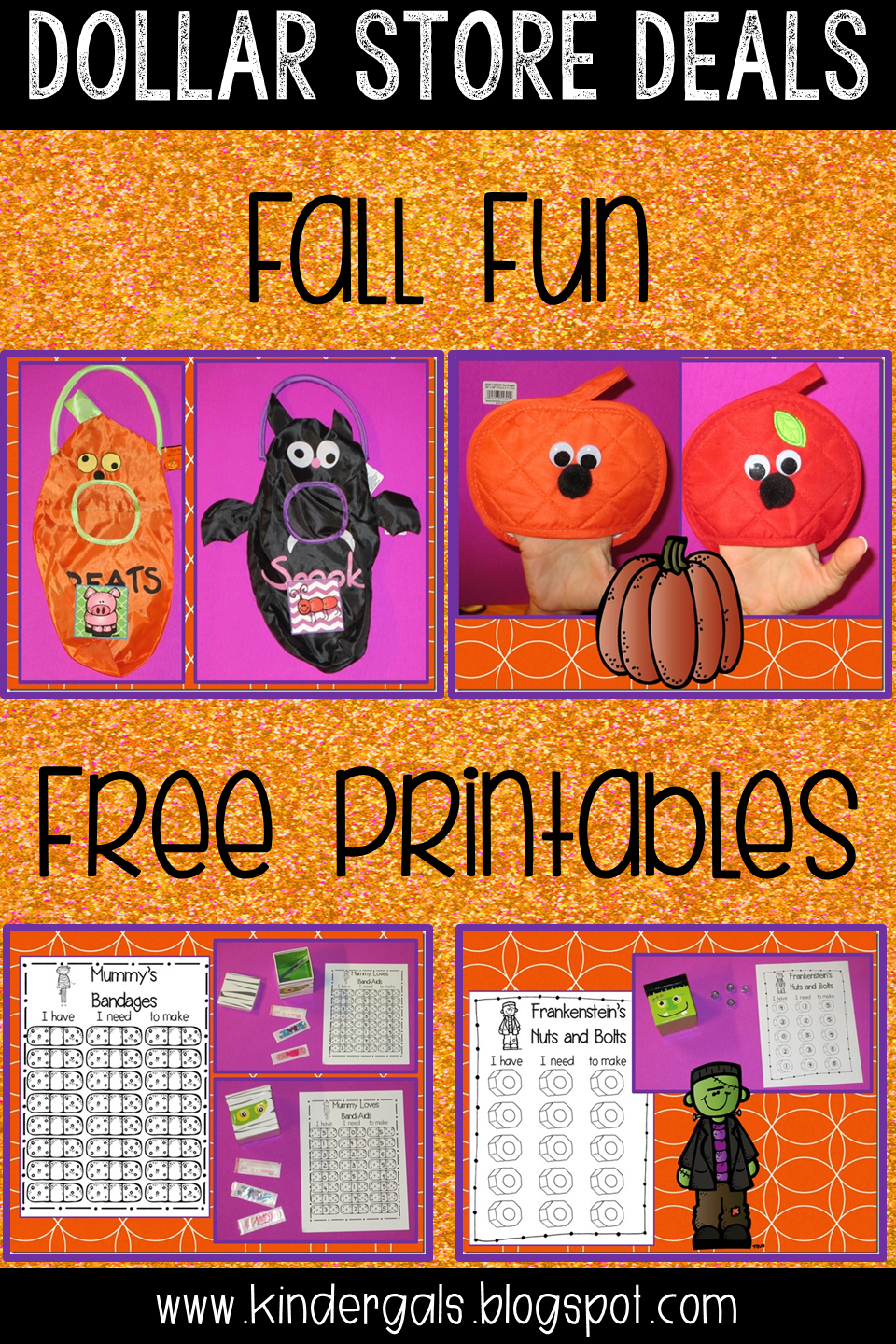
This post has some fun ideas for using dollar store finds to engage your kiddos! There are also 2 free printables ready to go!
Slide1

The dollar spots are full of fun things for Fall! Here are a few find from this week.
Love the note pads for write the room.
The tins are great to store games.
Slide2
The glasses are fun for read the room. I always have a “light” on my teaching table. If I have it turned on, then the kids know not to interrupt me. Love the pumpkin light. I love the felt stickers for sticker stories. I give the kids a sticker to use in their illustrations. Then, they write a story to match their illustration.
Slide3
Love these trick or treat bags. I used a piece of velcro to attach a picture on the front. They are going to sort small toys or picture cards into the bags. In this case, it is 2 different games. Day 1, have children find all the pictures or toys that start like pig and put them in the bag. Day 2, have the children find all the pictures that end like ant and put them in the bat bag. Slide4
Loved these pot holders in the target dollar spot. I added wiggly eyes and a pom pom nose. Now I can use the pumpkins (I made 5) to act out the Five Little Pumpkins song. The apple is for the Way Up High in an Apple Tree poem.
Slide5
Found these clear plastic pumpkins in Target, too. The game boards are from my Math Attack pack. Instead of using the pumpkin clip art I am going to use these.
Slide6
Target also has the clear plastic leaves and acorns.Slide7
This mummy box is so flippin cute!  I walked around with it in my hand for a while so I could think of what I could do with it. So here’s what I came up with:
1. Put a given numeral of bandaides in the box. Put the kids in a circle and pass the box around while you play music. When the music stops, whomever is holding the box, spills the bandaides and counts them. This is great for practicing cardinality. After they count them, ask “So how many bandaides are in the box?”  If they look at you and say the number, then they have cardinality. If they count again, they don’t. Cardinality means that the last number said tells how many are in the group.
2. Here’s another game. Decide if you want to play how many to make a 5 or how many to make a ten. Count out that many bandaides. Put some of them in the box and put the lid on. Now put the rest on the table. The children have to figure out how many are in the box by looking at how many are on the table. Is it too hard for them? Then use a 5’s frame or a 10’s frame to help them build that mental image.
Slide8
They also had this Frankenstein box! So you can play the same games using the bolts.
Grab the recording pages for the Mummy’s Bandages and Frankenstein’s Nuts and Bolts at the bottom of this blog post.

Pin It!

Tuesday, October 22, 2013

Developing Vocabulary

Vocabulary is essential to success! This post shares how we teach our kids academic vocabulary as well as content vocabulary.
Slide2
Well the day finally arrived. The day after Matthew turned 5 months old Megan headed back to kindergarten. We are all so glad that she took an extended time off to be with him. Not only was it good for Matthew, it was good for Megan to see that she “wanted” to work. She loves teaching and would miss it terribly if she was home all day. Her first day back was great. She was super excited about what her kids could do. Ms. Kristi did a great job getting them this far!Megan received lots of love letters during writer’s workshop. Man….can they write! So where does this leave me now that my shopping partner is back at work? At home with Matthew! He is such a joy, but lots of work. I know now why young people have babies! I am so excited that I was able to cut back on work this year to stay home with him 3 days a week and only travel Sunday to work Monday and Tuesday!
Slide3
Last week Megan started preparing herself for going back to work. She ironed her clothes, loved on Matthew and got some “teaching” things together. She decided that she needed to have some things that she did every week, repeating the same basic idea. She doesn’t want to have to stay really late prepping materials. Here are a few of the things she put together to help with vocabulary.

Academic Vocabulary

Each week we pick one math word and one literacy word that we want to take to a deeper level of understanding. These are the words that are REALLY important for the kids to understand. My kindergarten team worked together to determine which words they need a firm understanding of to be successful in first grade. Then, each week we spotlight those words. First, we have the kids draw a picture of what the word means. This is called a nonlinguistic representation of the word.  Next, we all meet together on the carpet. We talk about the word and come up with "our definition". We should NOT give the kids a definition. Instead we want them to create their own. This is evidence of a deep understanding of the word.
Here is Megan's idea...Instead of creating the chart each week on chart paper, just make it on a piece of poster board. She laminated the board so that she can use the same board every week. Children’s non linguistic representation of the word is drawn on post it notes and stuck to the chart. She attaches paper to the other section to have the children generate a definition. You can get the letters here to make the title "Vocabulary" for your chart.
 
Both the Literacy and Math Academic Vocabulary are in this bundled unit.
https://www.teacherspayteachers.com/Product/Academic-Vocabulary-Interactive-Journal-Bundle-by-Kim-Adsit-1082432

Content Vocabulary

Content Vocabulary are Tier 3 vocabulary words. That means they are words that you need if you are engaged in the topic.  It is very important to develop content vocabulary in order for children to comprehend nonfiction text. We use an ABC Chart for organizing our Content Vocabulary.
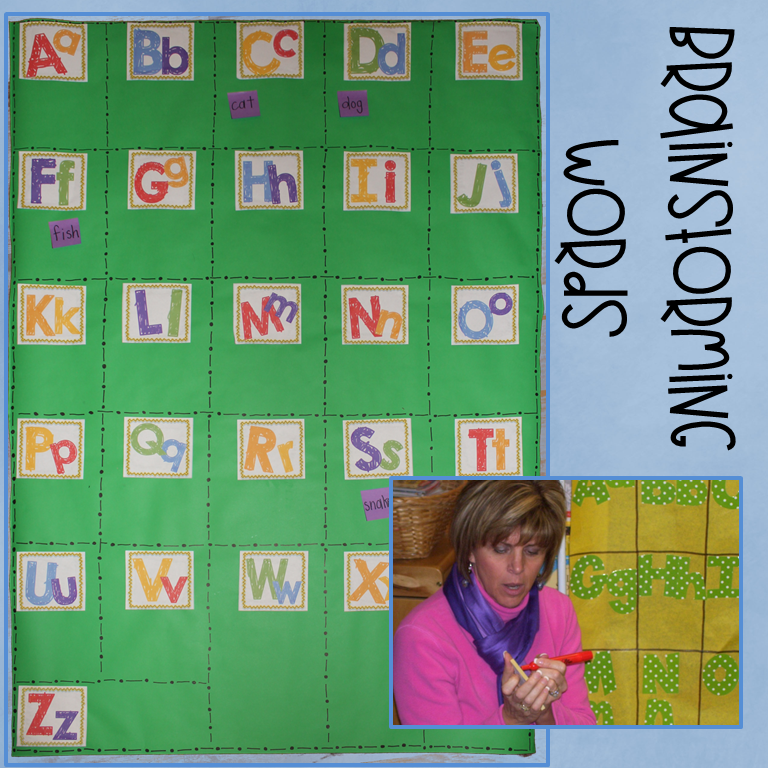
Each week, during our word work time, we brainstorm content vocabulary words. If it is a new unit, the children are sharing words from their existing knowledge of the topic. The second and third weeks of the unit, the children are sharing words that they are learning.  As the children share words, I write them on post it notes and attached them to the abc chart by their beginning letter.
As I am writing them on the post it notes, the kids are adding the words to their Unit Vocabulary Notebooks. These are a great tool for writing!
 Megan made her chart on two sheets of poster board that she taped together after she laminated them. (She was really quick to tell me that hers was cuter!  Smile)
https://www.teacherspayteachers.com/Product/Morning-Meeting-Pack-It-Learn-It-by-Kim-Adsit-750309
This idea is part of our Pack It! Learn It! unit.
Pin It!

Wednesday, October 16, 2013

Thrifty Thursday—How to Shop the Dollar Store

Who doesn’t love a trip to the Dollar Store? Don’t you get a rush when you see all that stuff you can get for only a dollar? Do you automatically check out the Dollar Spot when you go to Target? Well then, you make have an addiction….So from one addict to another, here are my best tips for shopping the dollar store:
1.  Shop with a friend. It is amazing how much more creative I am when I am shopping with someone else. 
2. Go down every isle. Don’t just look on the isle with the teacher items or the toys. Look at every item and ask yourself, “What can I make with that?” or “How can I use that to make my classroom more organized and efficient?”
3. Go to every dollar store and go often. There are lots of discount stores that I like—Big Lots, Fred’s, Dollar General, Dollar Tree, Target. 
Here are some things I picked up at the Dollar Tree this week:
Slide1
Love the glasses for read the room! Julie Lee has a cute game where she used sunglasses for an addition center. It is in her Weather Unit .  http://www.teacherspayteachers.com/Product/Whats-the-Weather-Math-Literacy-Centers-512075
The skeleton is great for hangman. Not sure how I am going to use the jack o lantern and skull. I’m thinking part/part/whole or cvc words. 
Slide2
This mouse makes a great math game. Buy enough mice for a small group. Remove the string tail and add a pipe cleaner as the tail. Now, to play the game, invite the children to roll a dice. Whatever numeral is on the dice, have them put that many pony beads on the pipe cleaner. Roll again. Look at the numeral on the dice. How can you make it so that your pipe cleaner has that many beads. For example, first they roll a 5 so they put on 5 beads. The second time they roll a 3. So they need to take 2 beads off. Keep rolling and have the children either add more beads or subtract some so that the number of beads matches the numeral on the dice.
So who else has a dollar store obsession? I’m going to try my first linky! Each week let’s share our thrifty idea of the week. It could be something that you picked up at the Dollar Store. Or, it could be something that you are recycling and using “trash” in a unique way. I have done a lot of dollar store posts in the past. Here are links to some of them:
http://kindergals.blogspot.com/2013/08/dollar-store-deals.html
http://kindergals.blogspot.com/2013/04/wanna-go-to-dollar-store.html
http://kindergals.blogspot.com/2013/03/teachers-gone-wild-dollar-store-style.html
http://kindergals.blogspot.com/2012/07/4th-of-july-dollar-store-trip-and-look.html
http://kindergals.blogspot.com/2012/07/thrifty-thursdaywords-and-phonemes.html
http://kindergals.blogspot.com/2013/04/whats-at-target-dollar-spot.html
http://kindergals.blogspot.com/2012/06/thrifty-thursdays-feather-duster-ducks.html
http://kindergals.blogspot.com/2012/06/thrifty-thursday-counting-games-number.html
http://kindergals.blogspot.com/2012/06/more-puppets-for-thrifty-thursday-five.html
So link up below with a “Thrifty Thursday” tip! Can’t wait to see them!

Pin It!

Saturday, September 21, 2013

Interactive Post It Note Anchor Charts

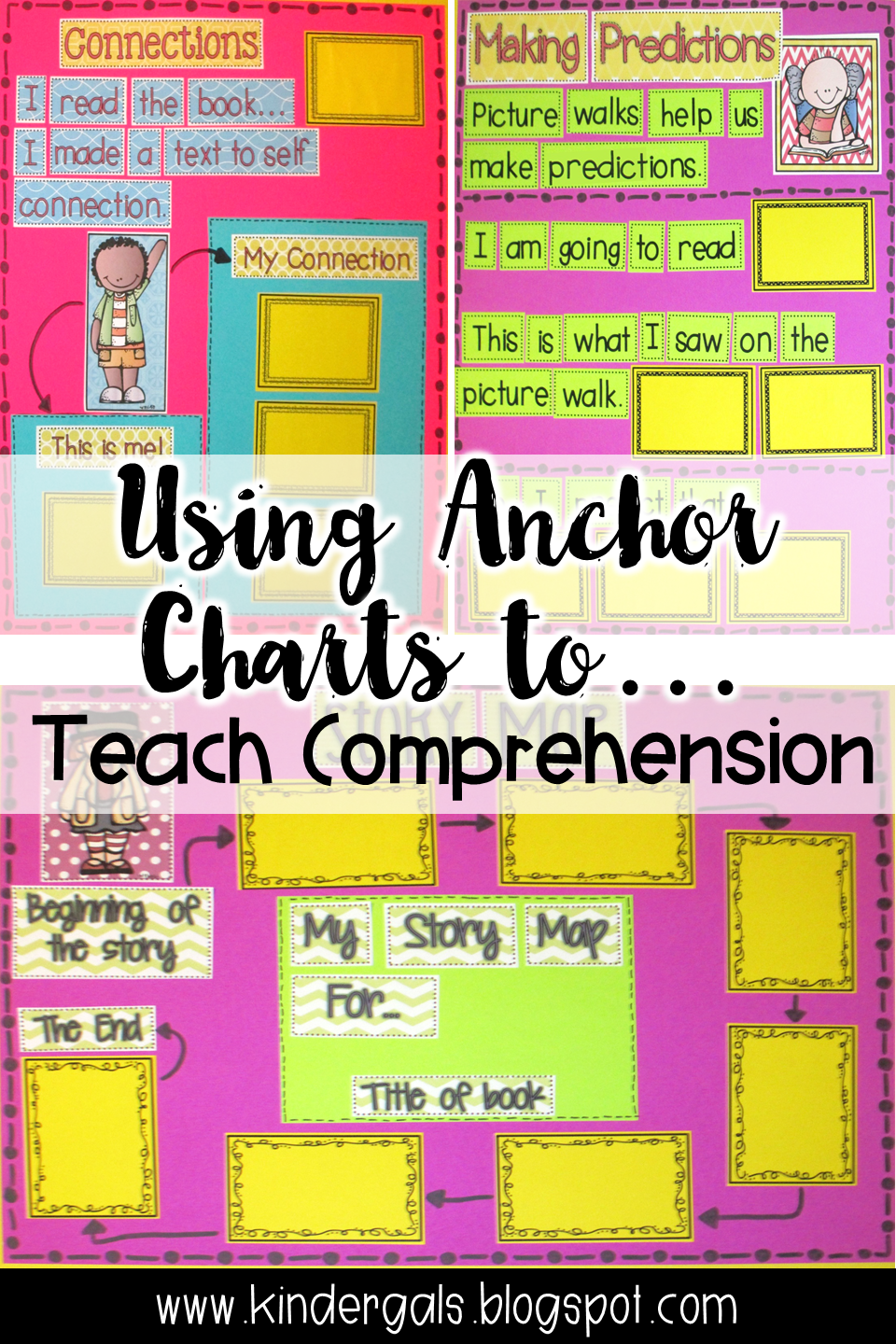
Just had a  “If You Give a Mouse a Cookie” experience. Two weeks ago I started revamping some of my older presentations when I decided that my comprehension session needed a serious facelift.  One of the things that I share in that session are some anchor charts that I made for teaching reading comprehension. Well, to say the least, they were looking pretty bad. Old, worn out, faded, “ugly” clip art, and **GASP** parts of them were handwritten!  Well two weeks later and I finally finished up my set of Interactive Post It Note Anchor Charts. In all I made 21 interactive post it note anchor charts for teaching various comprehension strategies. There are charts for: Story Elements, Retelling, Story Maps, Making Predictions, Inferences, Connections, Vocabulary, Fiction/Non Fiction, Characters, Partner Work, and Questioning.
Now, these charts do require assembly and are full color. And while it does take some time to put them together, once completed they can be used over and over again with various pieces of text…no more wasted chart paper. I took a full color photo of each chart so that you can use it as a sample for easy assembly. Also, on the same page as the photo, I  suggested some ways to use each chart.
So why do I use these charts? Well, they provide a framework to model the comprehension strategy. It gives the brain a safe place to rest, a predictable format that allows the brain to focus on the new material. It is a connector, a link for the brain.  They provide the teacher a framework where you can share your thinking as you model how to go through the process. They also allow for active engagement, an essential part to any mini lesson. You will invite the children to record their thinking on post it notes and then organize them on the chart.

Here are a few comprehension anchor charts:
Stories Have a Beginning, Middle and End
Slide3
This  chart can be used with ANY story. After reading the story, have a discussion about what happened at the beginning, middle and end of the story. Record the thoughts on post it notes and stick them to the frames. You may want to do the beginning and ending as a group. Then, give each child a post it note and have them write, or draw, something that happened in the middle. You can stick post it notes on top of each other that recall the same event. More frames are on the chart for the middle to show that most of the story is in the middle.
Text to Self Connections
Slide40
After reading a story, write the title on a post it note and stick it to the chart. Be sure and pick a book that MANY children will have a connection to. There may be a book with various events so that children may make connections to different things. Model, using the chart, how you made a connection to something from the story and how it helped you as a reader. Discuss possible other connections. Now give the children a post it note. Invite them to record a connection to one of the events in the story. Ask, "How does that help you as a reader?"
Making Predictions
Slide70
Before reading the story, write the title on a post it note and stick it to the chart. Invite the children to follow along as you turn the pages to discuss what you see happening in the story. Record your ideas on post it notes and stick them to the chart. Remember you can stack the post it notes if you have more than two things you whish to write. Now, model for the children how you can use that information to make a prediction about what is going to happen in the story. Or, give the children a post it note and have them record the information as you turn through the pages.
https://www.teacherspayteachers.com/Product/Reading-Comprehension-Interactive-Sticky-Note-Anchor-Charts-881320
These ideas are from The Interactive Post It Note Unit.
You can get the anchor chart pack (here).
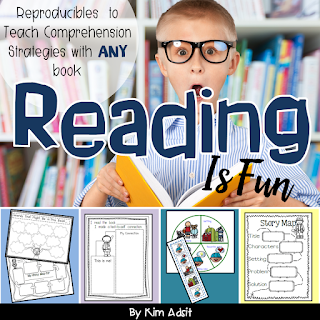
The anchor charts were designed as a companion for the Reading Is Fun! pack that contains reproducibles for student reading response. Once you model on the anchor chart, these reproducibles can be used as a center, reader’s response, or as an entry to their reading journal.
https://www.teacherspayteachers.com/Product/Reading-Comprehension-Reading-is-Fun-98783
You can those reporducibles  here:
https://www.teacherspayteachers.com/Product/Reading-Comprehension-Bundle-Reading-Is-Fun-1306543
Or here is the bundle:
Pin It!

Thursday, September 19, 2013

Using Interactive Charts in Math and Literacy

Do you use interactive chart? They have been around for a very long time. I was thinking it was a good time to revisit interactive charts and how to get the most bang for our buck!
Here are a few things about Interactive Charts:
  • Interactive Charts are usually songs or poems.
  • They have pieces that are attached with velcro or magnets that the children can take on and off.
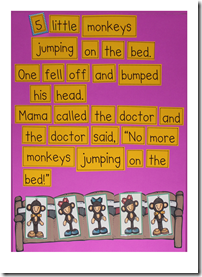
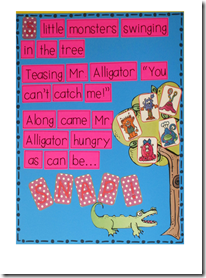
  • They can be used as an “attention getter”, a shared reading, a center, a math lesson (All the 5 little this and the 5 little that type songs are great for numbers to 5)…..
  • Pick songs and poems that you do often, your favorites. If you pick ones that you don’t love, you won’t use them.
  • Close your door and SING! I have a terrible voice. And to make matters even worse, my sister was a voice major in college and actually sang opera and taught music for many years. She absolutely dies when I tell her that I sing in front of teachers. But, when I am at a conference and I am talking about charts and songs…I do it! Now it might make your ears bleed, but the kids don’t seem to mind! The advantages and the benefits far outweigh how bad I sound!
Slide5Slide5Slide5
When using charts, decide your standard. Are you going to work on spaces between words, tracking print left to right, some words we know fast. Or, are you going to use them during math and focus on combinations for 5, subtraction, addition, one more, one less. Then, after singing the song for enjoyment, revisit the song during your literacy or math block with an intended standard.
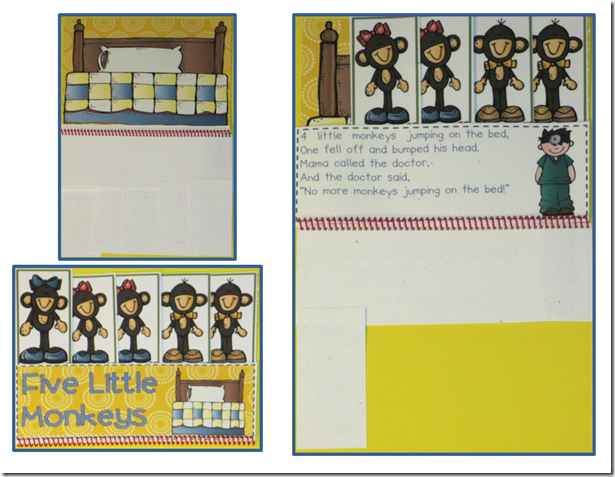
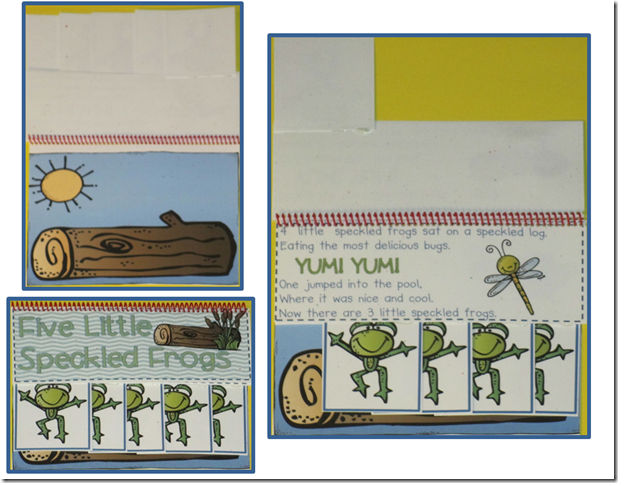
I also made the songs into a flip book. Wonder why I need both? See here’s what I know…when you are reading the kids a book about 5 little monkeys and you turn the page and now there are 4 little monkeys because one fell off the bed….the kids see those as 4 different monkeys—not 4 of the same ones as on the first page. This is because children don’t have conservation of number, they also lack cardinality. So by making the flip books where the monkeys sit along the top edge, they can see the monkeys “leave” as you flip down the page.
Slide21Slide22Slide21
Hope this helps explain the idea of interactive charts a little bit better. Each of these charts are on tpt and you can find them by clicking on the photographs. If you already have them, go to your My Purchase and download it again. The clip art is way cuter and the number flip books weren’t in the original pack. And in case you just need them all....here is a bundle! :)
https://www.teacherspayteachers.com/Product/Sight-Word-Readers-and-Interactive-Charts-Bundle-1306552
Pin It!

Tuesday, September 17, 2013

Using 5 Little Ducks to Teach Math and Literacy


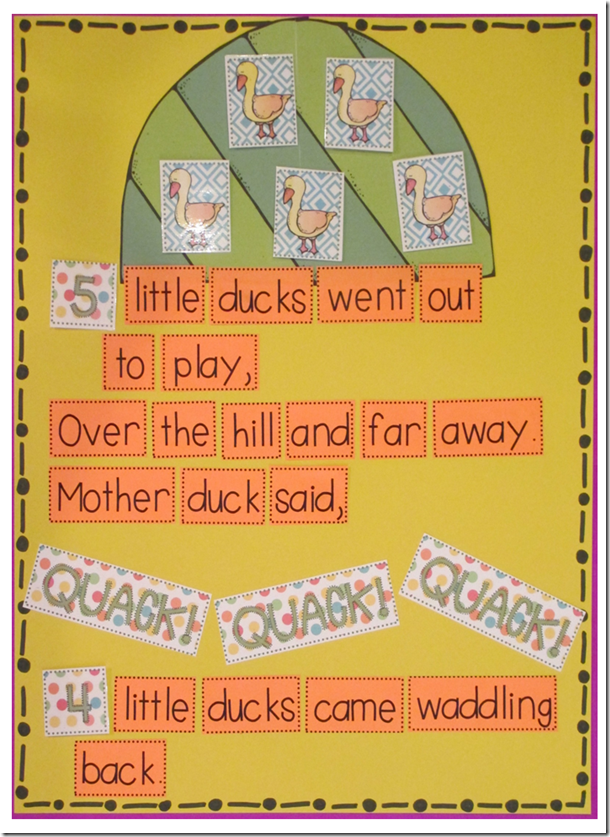
Five Little Ducks is a song that I think every teacher knows. When I first started teaching, I learned lots of fingerplays and songs. But it wasn't until much later that I knew the power of songs and chants in the kindergarten classroom. Here's a few things that makes songs and chants powerful.

Five Little Ducks

Slide5

Literacy

  • When singing with kids, children develop prosody. Prosody is the natural rhythm in fluent reading. The only ways to develop prosody is through songs, poems, and chants AND through repeated reading.
  • Charting your songs is also beneficial. By charting the song children see the text to talk connection. You can use the chart to teach any concepts of print--letters, words, directionality, punctuation, capital and lower case, etc.
  • When the chart is interactive, children can take an active role in the reading.

Math

  • When using songs and charts in math, you must first decide on the standard. Do you want to teach counting, one less, combinations for 5, subtraction, etc.?
  • Be sure the standard is kept front and center. As you are singing the song, keep using the language to teach the standard. For example, after singing the song you might say, "There were 5 ducks but one went away. What number is one less than 5?" OR " There are 4 ducks in the pond, how many have gone away?"
Slide19
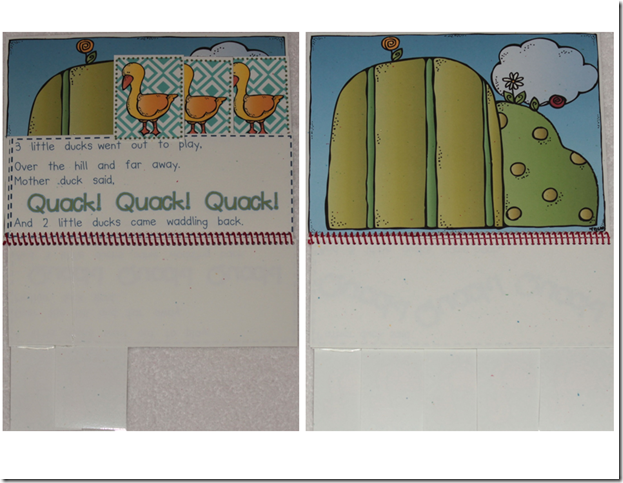
  • Making the song into a little book is also useful. When children are learning any new mathematical concept, the learning should begin at the conceptual level. Conceptual level means to manipulate. Think about this: When reading the library book "5 Little Ducks" the children think that when you turn to the page with 4 ducks, these are 4 NEW ducks---the 5 ducks are still on the page before. This means that children at the conceptual level truly don't understand the mathematical concept that you are trying to teach. (Reading the book is at the pictorial level.)
  • When reading the song book and turn the pages, only one duck is moved. The 4 other ducks remain at the bottom.
  • Does this mean that we shouldn't read library books with math concepts. NO, not at all. However, think of how you can work at the conceptual level so that the children understand. Think about having 5 plastic ducks or 5 clip art images. Then, as you are reading the book, manipulate the ducks to show the kids what is happening.
https://www.teacherspayteachers.com/Product/Sight-Word-Reader-and-Interactive-Chart-Five-Little-Ducks-97420
You can find this chart and book in the 5 Little Ducks Interactive Chart unit.
Pin It!
 
Pin It button on image hover

Receive All Free Updates Via Facebook.